Every established vape buyer eventually faces the same procurement decision: continue importing directly from a factory in China, buy from a European warehouse, or combine both channels.
The correct answer depends on more than the quoted unit price. Lead time, minimum order quantity, customs responsibility, cash tied up in transit and the cost of correcting a forecast all contribute to the real landed result.
Factory direct vs local EU stock at a glance
| Evaluation factor | China factory-direct shipment | Local European warehouse stock |
|---|---|---|
| Best suited to | Planned, validated volume | Rapid replenishment and controlled testing |
| Typical route | International freight plus EU import | Regional parcel or road network |
| Order size | Commonly higher and SKU-dependent | 10-piece display-box increments in the FIZZY model |
| Customs responsibility | Depends on the agreed Incoterm and importer | Original import handled before local stock is offered |
| Cash commitment | Longer period before stock is saleable | Shorter regional replenishment cycle |
| Assortment flexibility | Lower after production is confirmed | Higher when several models are physically available |
| Returns and exceptions | Cross-border resolution | Regional handling may be simpler |
These are structural differences, not guarantees. A strong factory programme can be reliable and economical, while a poorly managed local warehouse can still create problems. Supplier verification remains essential in both models.
Where factory-direct sourcing wins
Direct purchasing is often the right choice when the buyer has stable demand and can plan well ahead. Its main advantages are:
- access to production-scale pricing;
- deeper customisation or private-label options;
- direct technical communication with the manufacturer;
- efficient replenishment of proven, high-volume SKUs; and
- the ability to negotiate packaging or specification changes at source.
For distributors with sufficient working capital, warehouse space and import expertise, these benefits can justify a larger order and a longer supply chain.
FIZZY’s emphasis on proprietary hardware development is explained in why in-house R&D matters for high-puff vape wholesale.
The costs a factory quote does not always show
The ex-factory or FOB unit price is only the beginning of the landed-cost calculation. Buyers should model:
- international freight and battery-cargo handling;
- insurance and freight-forwarder charges;
- customs brokerage, duties, VAT and any excise treatment;
- storage and receiving labour;
- capital cost while the goods are in production or transit;
- the cost of excess or obsolete flavours; and
- the practical cost of resolving damage or specification disputes across borders.
A small difference in unit price can disappear if the buyer over-orders a weak SKU or misses several weeks of sales while waiting for replenishment. Conversely, a well-planned factory order for a proven seller may deliver a clear cost advantage.
Where a European warehouse wins
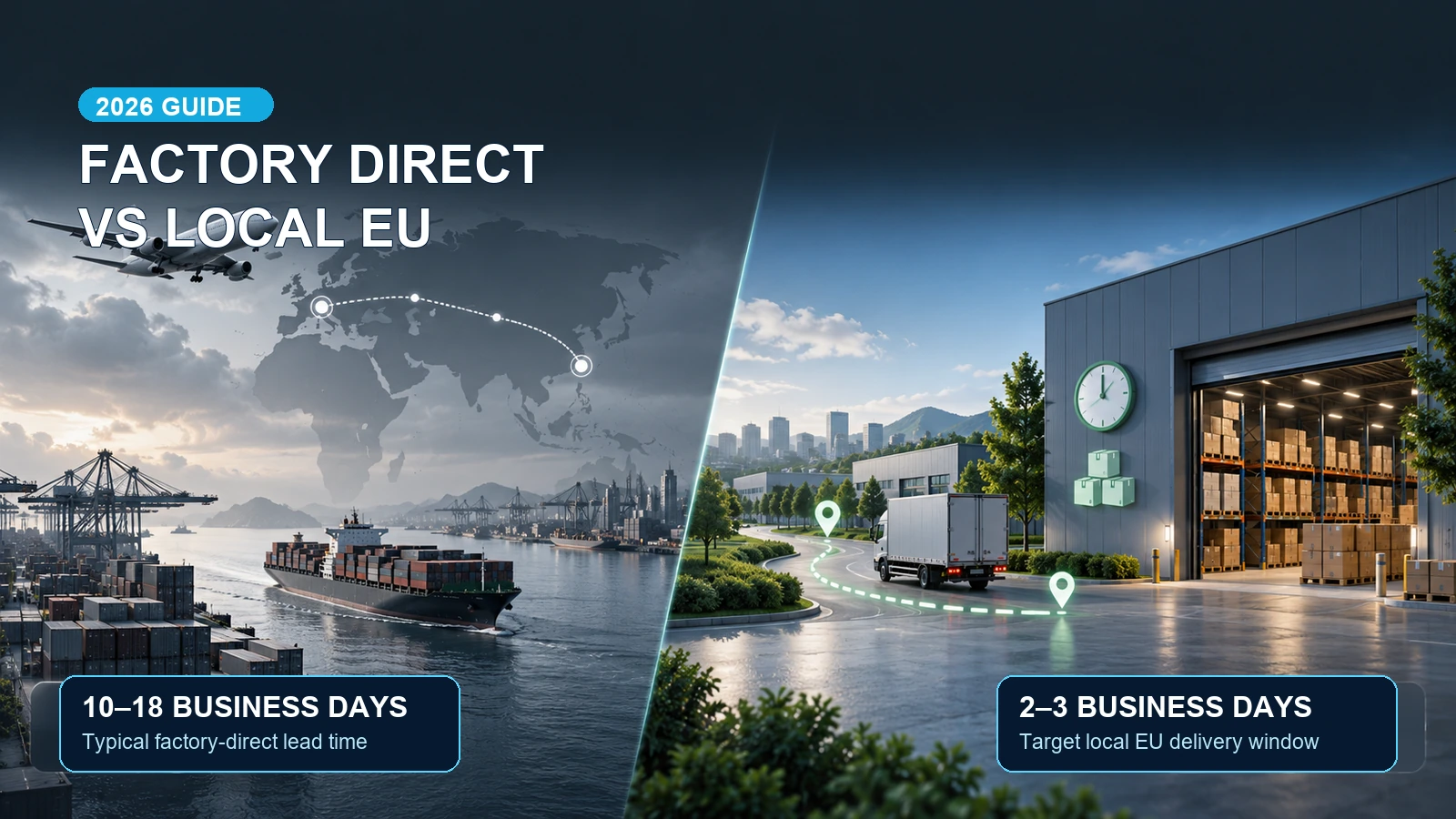
Local stock is designed for speed and optionality. In FIZZY’s current model, retailers can order 10-piece display boxes from European inventory and use DPD, UPS or CTT, with a stated 2–3 business day target for core markets.
That structure is useful for:
- testing a new model or flavour in a limited quantity;
- replenishing a fast seller before the next bulk shipment;
- diversifying the assortment without committing to a factory minimum for every SKU;
- responding to a temporary demand spike; and
- reducing exposure to a new third-country customs event on each small order.
The customs distinction is explained in our guide to pre-cleared DDP vape stock and EU customs-clearance risk. The operational workflow is covered in the main European vape wholesale warehouse DDP guide.
Compare the two models with total landed cost
Use one worksheet and compare the same sales period. Include:
- purchase price;
- all freight and import charges;
- payment timing;
- expected arrival date;
- units likely to sell at full price;
- markdown allowance for slower SKUs;
- storage and handling cost; and
- exception or return cost.
Then run at least three scenarios: expected demand, demand 25% below forecast and demand 25% above forecast. A sourcing channel that looks cheapest only in the perfect forecast is often less resilient than it appears.
The strongest answer is usually a hybrid system
Many retailers do not need to choose one channel permanently.
Use factory-direct sourcing for core SKUs with dependable demand, sufficient lead time and a meaningful landed-cost advantage. Use the European warehouse for new-product tests, selective flavour replenishment and urgent gaps. As a test SKU becomes proven, it can graduate into the planned factory cycle.
This hybrid model separates strategic buying from tactical replenishment. It also avoids paying a local-stock premium on every unit while preserving a faster option when the sales forecast changes.
The low-MOQ 10-piece vape wholesale model and fast European restocking guide show how the tactical layer works in practice.
Make the 2026 procurement decision
Choose factory direct when volume is validated, lead time is available and the full landed-cost calculation supports it. Choose local European stock when flexibility, small increments and regional delivery matter more than the lowest theoretical unit cost. Use both when the business needs efficiency and resilience at the same time.
Before ordering, compare the live specifications for FIZZY TWINS 50K, FIZZY SMART 150K and FIZZY MAX III PRO 120K so that the commercial quote matches the intended hardware.
Then ask the FIZZY European wholesale team to compare landed options against your latest factory-direct invoice.